Accoya Windows – Class 1 Durability and Exceptional Stability
Accoya windows are available at SM WOOD exclusively on the IV92 and D92 profiles. Accoya is not a wood species. It is Pinus radiata – a pine planted in New Zealand and Chile – chemically modified through acetylation by Accsys Technologies. The process transforms hydroxyl groups into acetyl groups: the wood absorbs dramatically less water, fungi have no nutritional substrate, and dimensions remain stable regardless of humidity. The result: the only species in our range with Class 1 natural durability that also maintains a λ 0.12 W/m·K (EN 12667).
Density 515 kg/m³
Mass
λ 0.12 W/m·K
Thermal conductivity
Durability Class 1 (EN 350)
Rot resistance
Class 1 Durability, without thermal compromise
Accoya combines maximum durability with the thermal performance of softwoods. The acetylation process chemically transforms the cellular structure of Pinus radiata, resulting in Class 1 natural durability and a thermal conductivity of only 0.12 W/m·K (EN 12667). All other Class 1 species have much higher density and λ (merbau λ ~0.19 W/m·K, afzelia λ ~0.19 W/m·K).
At SM WOOD, Accoya is available exclusively on the IV92 and D92 profiles. The more massive geometry of the IV92 profile compensates for Accoya's lower modulus of elasticity compared to traditional species, ensuring the same structural reliability as our standard profiles.

Technical Data
|
Property |
Value |
|
Density |
515 kg/m³ |
|
Janka Hardness |
4,100 N (tangential) |
|
Bending Strength |
39 MPa |
|
Modulus of Elasticity (MOE) |
5.29 GPa |
|
Compressive Strength |
22.4 MPa |
|
Radial Shrinkage |
0.7 % |
|
Tangential Shrinkage |
1.5 % |
|
Thermal Conductivity (λ) |
0.12 W/m·K |
|
Natural Durability Class |
1 (maximum through acetylation) |
What these figures mean for joinery: The radial shrinkage of 0.7% and tangential shrinkage of 1.5% are the lowest in our entire range. Accoya is 4-5 times more dimensionally stable than spruce. In practice, an Accoya profile does not warp or jam during humidity changes. λ 0.12 W/m·K (EN 12667) – a very good thermal coefficient. MOE 5.29 GPa is the lowest in the range; on IV92 the massive profile compensates perfectly. Janka Hardness 4,100 N – higher than spruce (1,680 N), Nordic pine (2,420 N), meranti (2,460 N), and larch (3,290 N), though oak remains the choice for heavy-traffic thresholds.
Performance in Windows
Accoya delivers Class 1 durability with the thermal performance of a softwood, making it unique for demanding exposures.
1
Thermal
λ 0.12 W/m·K (EN 12667). The Uf-value of the Accoya frame on IV92 is similar to IV92 spruce. Uw at standard configuration: calculated on request for PHPP.
2
Dimensional Stability
0.7% radial and 1.5% tangential shrinkage – 4-5x better than spruce. (ISO 4469, wet→oven dry) For a 1230×1480 mm sash, variation is under 1 mm compared to 3-4 mm for spruce.
3
Durability
Class 1. In difficult exposures – south-facing without roof, marine climate, mountain freeze-thaw – Accoya functions predictably long-term without frequent maintenance.
Behavior Over Time
Accoya's acetylation ensures long-term performance even in the most demanding environments.
Class 1 Durability
Acetylation chemically transforms the wood cells – fungi and rot cannot settle without access to hydroxyl groups. Maximum biological resistance without post-manufacturing treatment.
Weathering
The uncoated surface becomes silvery-grey upon UV exposure – not structural degradation. With a factory-applied Remmers finish, colour remains controlled and stable.
Maintenance Interval
With at least 4 layers of Remmers applied in the factory, follow the documented maintenance schedule. The tolerance margin for delayed maintenance is higher than for any other species in the range.
Dimensional stability (0.7% radial) means sashes do not warp, jam, or leave gaps during seasonal humidity changes – especially important in periodically unheated homes.
Advantages of Accoya
Advantages
Disadvantages
Comparison with Other Species
See how Accoya stacks up against the most common alternatives in our range.
Accoya vs Spruce
Spruce wins on cost and lead time. Accoya wins on natural durability (Class 1 vs Class 4) and dimensional stability (0.7% vs 3.9% radial). Similar λ (0.12 vs 0.11). For standard nZEB houses, spruce covers the requirement. In difficult exposures or where rare maintenance is a priority, Accoya makes sense.
Accoya vs Oak
Oak wins on hardness (4,980 vs 4,100 N Janka), appearance under stains, and availability. Accoya wins on durability (Class 1 vs 2), thermal performance (λ 0.12 vs 0.18), and dimensional stability (0.7% vs 4.7% radial).
Accoya vs Merbau/Afzelia
Merbau and afzelia have Class 1-2 durability, but λ ~0.19 W/m·K compared to Accoya's 0.12. For projects with nZEB requirements and strictly calculated Uw, Accoya is the only Class 1 species that does not penalise Uw.
Appearance and Colour
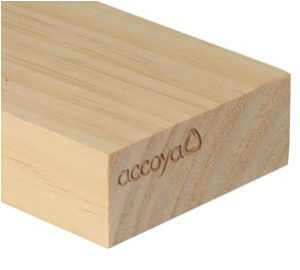
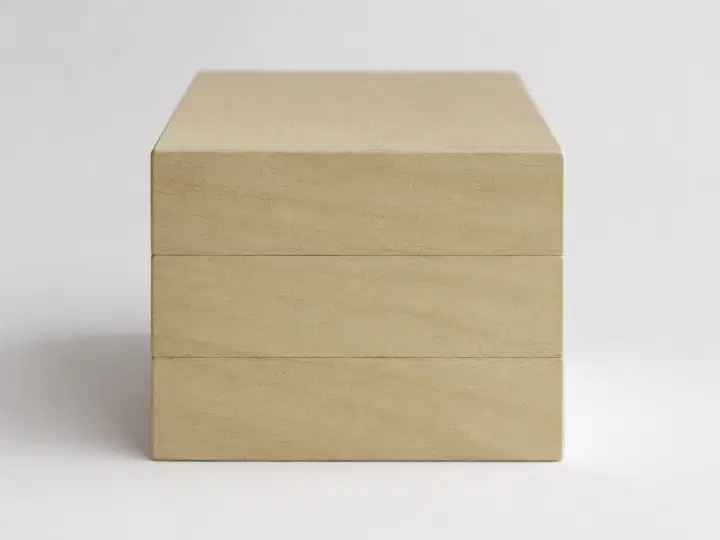
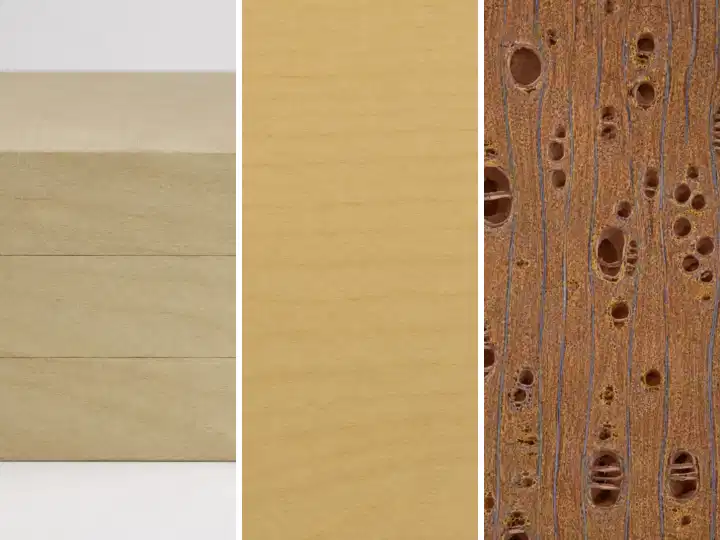
Creamy-white with a slight yellow tint – similar to spruce before acetylation. Grain with uniform helical deviation, narrow annual rings. Under RAL opaque paint, visually identical to any other wood. Under translucent stains, the grain is discreetly present, without the expressiveness of hardwoods. Accoya is not chosen for aesthetics – it's chosen for technical performance.
Availability & SM WOOD Execution
Key Details
The price varies depending on profile (IV92/D92), opening size and configuration – request a free quotation. For B2B projects: we provide Ud, Uf, Ug and PHPP data on request.